First Responders Complete Applied Mental Health Program
Lori Trimmier | 5/22/2026
 Clearwater Police Sgt. Corey Lenczden
Clearwater Police Sgt. Corey Lenczden knows all too well the toll that law enforcement work can have on an officer’s mental health. The 25-year police veteran spent much of his career investigating sex crimes and has seen his share of trauma.
"We were taught to compartmentalize everything we saw. Over time, you realize that’s not a long-term solution," Lenczden said.
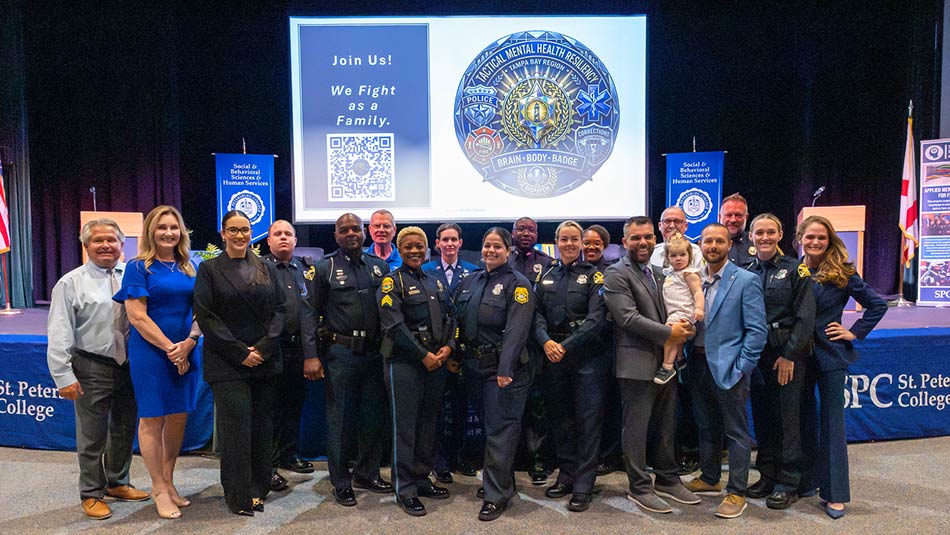
Lenczden was one of fourteen first responders who graduated this month from the Applied Mental Health Advanced Technical Certificate program. Graduates were recognized at a ceremony on May 18 at the St. Petersburg College Clearwater Campus.
Developed in partnership with the Sun Coast Police Benevolent Association, the program equips first responders to serve as mental health liaisons and peer support advocates within their respective departments. For Lenczden, who enrolled because he lost a close friend and fellow officer to suicide, the program challenged long-held industry norms.
"There are so many resources and techniques out there that I didn’t know about before. It’s given me a better understanding of how to process what we experience in healthier ways and how to help others do the same," he said.
The ceremony marked the completion of the program’s third cohort, made of up officers from agencies across Tampa Bay, including the St. Petersburg Police Department, Tampa Police Department, Hillsborough County Sheriff’s Office, Clearwater Police Department, Pinellas Park Police Department and Bradenton Police Department.
Dr. Joseph Smiley, Dean of the College of Social and Behavioral Sciences and Human Services, welcomed guests to the ceremony. Opening remarks were delivered by Dr. Emmanuel Hernandez-Agosto, Interim Vice President of Academic Affairs, who praised the graduates' courage in confronting the stigma around mental health.
Redefining Resiliency
Research indicates one in three law enforcement officers experience symptoms of post-traumatic stress, compared to 6% of the general population. Nationally, law enforcement suicides continue to outpace line-of-duty deaths.
John Violanti, a 23-year veteran of the New York State Police and a research professor at the University at Buffalo, delivered the keynote address, telling graduates the program was built for community impact.
“The first responder program at this college was not built to change, it was built to transform," Violanti said. "You carry more than potential, you carry perspective.”
Graduate and Acting Sgt. Stephanie Robnett of the St. Petersburg Police Department also gave remarks, emphasizing that emotional wellness is just as critical to an officer’s well-being as any other safety essential.
“Mental health should not be viewed as anything less than a component of officer safety and another tool in our tool belt,” Robnett said.
She described the stress that first responders can experience in their personal lives.
“Over time, many of us become extremely good at functioning professionally, while slowly disconnecting personally," Robnett said. "We can create peace after responding to domestic disputes with a family that's not ours. But we can't always integrate into our own home lives or even help decide what we're going to have for dinner that night. This course challenged all of us to acknowledge those shortcomings.”
Robnett rejected the idea that professional strength requires emotional suppression.
“Resilience is not pretending that nothing affects you," Robnett said. "Resilience is recognizing problems early enough to intervene and address the underlying issues. For years, many of us were conditioned to believe that surviving this profession meant carrying everything alone. But isolation is not resilience.”
Partnership and Collaboration
Detective Rachel Hunter of the St. Petersburg Police Department, who graduated from the program in 2025, provided an update on the success of her class’s project. They created a mental health challenge coin that features a QR code linking officers to the First Responder Resources website, hosted by SPC, which supports the mental health and wellness of the broader public safety community. The challenge coin was created to serve as a reminder that help is always within reach.
“It says that we fight as a family, you’re not alone. We’re the first to respond but the last to ask for help,” said Hunter. She noted the impact the coin is already making. With more than 5,000 coins distributed to first responders across the country, Hunter has received multiple reports of how it provided critical help for some who desperately needed it.
For the 2026 class project, the graduating cohort created a two-day training seminar for regional first responders that will be held Aug. 27–28. The seminar, Tactical Mental Health Resiliency for First Responders, will condense key takeaways from the SPC program into practical coursework focused on resilience, identifying early warning signs and establishing healthy coping strategies for career longevity.
About the Certificate
The Applied Mental Health Advanced Technical Certificate program was developed in partnership with the Sun Coast Police Benevolent Association, in conjunction with support from the Pepin Family Foundation, which has played a critical role in covering tuition costs for first responders.
For more information about enrolling officers into the Applied Mental Health Certificate program for first responders, contact Dr. Latresha Moore, Human Services Program Director at (727) 497-5015.